What Michele is Reading

~ and some thoughts on same

Monthly Archives: November 2014

Finn, Sellen, & Wilbur. 1997. Video-Mediated Communication

13 Thursday Nov 2014

Posted by MJ in Uncategorized

≈ Leave a comment

Tags

groupware, ICT history, video mediated communication, VMC

This was a trip down memory lane. Not in a bad way.  A volume in the important series Computers, Cognition, and Work, the editors present 25 studies of what was then an emerging phenomena–both technologically and socially.  In the thick of things before the technology had standardized, before we were certain of the value of the enterprise, and before we knew what VMC was supposed to look like, this volume demonstrates how science and research pushes a field forward, imagining, exploring and creating possibilities rather than taking things as a given.

Resulting from a workshop held in 1994, the volume has four sections but what I think are really two halves.  The first half of the volume consists mainly of difference studies, as in, what is the difference between VMC and face to face, or this type of VMC and that type of VMC, or this technological infrastructure and another one. This type of study is typical when a new communication technology is developed or introduced. And they can be very useful in the moment, helping to guide technology development.

The second half of the volume is more interesting to me, given my own interest in using technology to imagine new, previously unimaginable, possibilities for communication and interaction (rather than working to recreate as closely as possible what we have now). These are chapters that present new designs and that imagine the future, by researchers well known now, including Steve Whittaker, Bonnie Nardi, Hiroshii Ishii, Christian Heath, Paul Luff, Paul Dourish, and of course Robert Kraut.
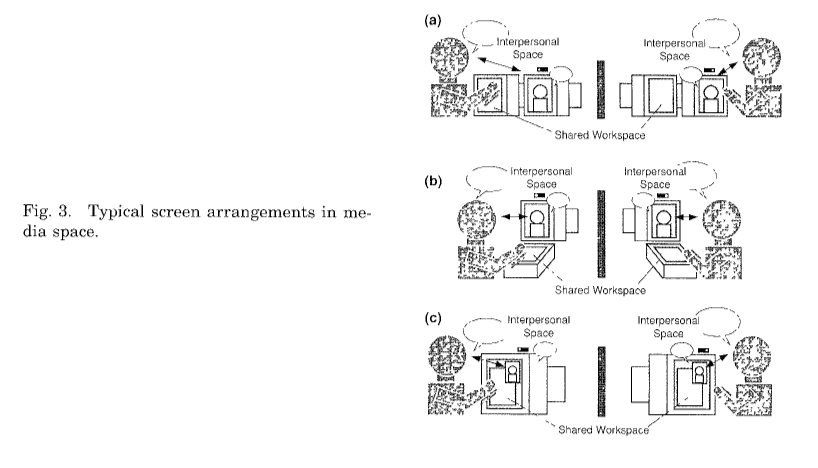
2014-11-10_1626The volume has captured in time ideas and designs that either were incorporated into technologies we take for granted today (such as Skype) or that were abandoned for any number of reasons.  EuroPARC’s RAVE. Bellcore’s Cruiser.  SunSoft Montage. MAJIC. NTT’s TeamWorkStation. DIVA virtual environment.  Xerox PARC’s media spaces. Active Desk. Portholes. Hydra. Rapport. Windseeker. This was a time of great imagination and possibility. Some of it is preserved here, to remember and to continue to inspire.

Finn, Kathleen E., Abigail J. Sellen, & Sylvia B. Wilbur. eds. 1997. Video-mediated communication. Lawrence Erlbaum Associates: Mahway, NJ.


Christakis & Fowler (2009), Connected

10 Monday Nov 2014

Posted by MJ in Uncategorized

≈ Leave a comment

Connection is the basis of communication.  But we don’t usually think of it.  So often when we study communication, we don’t consider the importance of how connection works, how it structures our actions (not only our relationships) and shapes our lives.

Christakis and Fowler see social networks everywhere.  Embedded in social network theory, their basic perspective will be familiar to most communication scholars.  Nodes and links and ties and configurations.  Yet they avoid the analysis that can make social network research overly technical and inaccessible to many. Instead, they demonstrate how paying attention to social networks can help explain human behaviors in a multitude of situations.  As they put it in the subtitle of their book, “The surprising power of our social networks and how they shape our lives.”

Connected

One strength of this book is that it takes the consideration of social networks beyond the typical study of configurations.  Instead, it seeks to demonstrate impact on specific behaviors and relationships that we wouldn’t necessarily have expected. Particularly for undergraduate students, topics such as close relationships, political behavior, the work world and the internet are relevant and accessible.  The book is rich with material for good class discussions.

This accessibility is useful as well for communication scholars who might not otherwise have considered the ways that social networks intersect with other areas of research. Interesting data visualizations help open some space for exploring these connections.  It was not a surprise to find that neither of the authors is from communication (Fowler, in fact, is a geneticist).  Once the authors turned to discussing the social aspect of network effects, the explanations often reflected either a deterministic perspective or a cognitive perspective. The role of communication, particularly its role in constituting our social world, was largely absent.

For more information, http://connectedthebook.com/

Christakis, Nicholas A. and James H. Fowler. 2009. Connected: The surprising power of our social networks and how they shape our lives. Little, Brown and Company: New York.

Recent Posts

  • Finn, Sellen, & Wilbur. 1997. Video-Mediated Communication
  • Christakis & Fowler (2009), Connected
  • Kappas & Kramer (2011). Face-to-face communication over the Internet
  • Cooper (2001). Ride the Wave
  • Koslow & Huerta, Kouzas (2000). Electronic collaboration in science.

Archives

  • November 2014
  • September 2014
  • August 2014
  • RSS - Posts

Tags

acceleration autopoiesis cmc collaboration collaboratories elearning groupware interdisciplinary jcmc lit review Luhmann organizations social construction strategic change systems telework theory

Blog at WordPress.com.

  • Subscribe Subscribed
    • What Michele is Reading
    • Already have a WordPress.com account? Log in now.
    • What Michele is Reading
    • Subscribe Subscribed
    • Sign up
    • Log in
    • Report this content
    • View site in Reader
    • Manage subscriptions
    • Collapse this bar
 

Loading Comments...