What Michele is Reading

~ and some thoughts on same

Category Archives: Uncategorized

Finn, Sellen, & Wilbur. 1997. Video-Mediated Communication

13 Thursday Nov 2014

Posted by MJ in Uncategorized

≈ Leave a comment

Tags

groupware, ICT history, video mediated communication, VMC

This was a trip down memory lane. Not in a bad way.  A volume in the important series Computers, Cognition, and Work, the editors present 25 studies of what was then an emerging phenomena–both technologically and socially.  In the thick of things before the technology had standardized, before we were certain of the value of the enterprise, and before we knew what VMC was supposed to look like, this volume demonstrates how science and research pushes a field forward, imagining, exploring and creating possibilities rather than taking things as a given.

Resulting from a workshop held in 1994, the volume has four sections but what I think are really two halves.  The first half of the volume consists mainly of difference studies, as in, what is the difference between VMC and face to face, or this type of VMC and that type of VMC, or this technological infrastructure and another one. This type of study is typical when a new communication technology is developed or introduced. And they can be very useful in the moment, helping to guide technology development.

The second half of the volume is more interesting to me, given my own interest in using technology to imagine new, previously unimaginable, possibilities for communication and interaction (rather than working to recreate as closely as possible what we have now). These are chapters that present new designs and that imagine the future, by researchers well known now, including Steve Whittaker, Bonnie Nardi, Hiroshii Ishii, Christian Heath, Paul Luff, Paul Dourish, and of course Robert Kraut.

2014-11-10_1626The volume has captured in time ideas and designs that either were incorporated into technologies we take for granted today (such as Skype) or that were abandoned for any number of reasons.  EuroPARC’s RAVE. Bellcore’s Cruiser.  SunSoft Montage. MAJIC. NTT’s TeamWorkStation. DIVA virtual environment.  Xerox PARC’s media spaces. Active Desk. Portholes. Hydra. Rapport. Windseeker. This was a time of great imagination and possibility. Some of it is preserved here, to remember and to continue to inspire.

Finn, Kathleen E., Abigail J. Sellen, & Sylvia B. Wilbur. eds. 1997. Video-mediated communication. Lawrence Erlbaum Associates: Mahway, NJ.


Christakis & Fowler (2009), Connected

10 Monday Nov 2014

Posted by MJ in Uncategorized

≈ Leave a comment

Connection is the basis of communication.  But we don’t usually think of it.  So often when we study communication, we don’t consider the importance of how connection works, how it structures our actions (not only our relationships) and shapes our lives.

Christakis and Fowler see social networks everywhere.  Embedded in social network theory, their basic perspective will be familiar to most communication scholars.  Nodes and links and ties and configurations.  Yet they avoid the analysis that can make social network research overly technical and inaccessible to many. Instead, they demonstrate how paying attention to social networks can help explain human behaviors in a multitude of situations.  As they put it in the subtitle of their book, “The surprising power of our social networks and how they shape our lives.”

Connected

One strength of this book is that it takes the consideration of social networks beyond the typical study of configurations.  Instead, it seeks to demonstrate impact on specific behaviors and relationships that we wouldn’t necessarily have expected. Particularly for undergraduate students, topics such as close relationships, political behavior, the work world and the internet are relevant and accessible.  The book is rich with material for good class discussions.

This accessibility is useful as well for communication scholars who might not otherwise have considered the ways that social networks intersect with other areas of research. Interesting data visualizations help open some space for exploring these connections.  It was not a surprise to find that neither of the authors is from communication (Fowler, in fact, is a geneticist).  Once the authors turned to discussing the social aspect of network effects, the explanations often reflected either a deterministic perspective or a cognitive perspective. The role of communication, particularly its role in constituting our social world, was largely absent.

For more information, http://connectedthebook.com/

Christakis, Nicholas A. and James H. Fowler. 2009. Connected: The surprising power of our social networks and how they shape our lives. Little, Brown and Company: New York.

Kappas & Kramer (2011). Face-to-face communication over the Internet

08 Monday Sep 2014

Posted by MJ in Uncategorized

≈ Leave a comment

Tags

cmc, face-to-face communication, interdisciplinary research

kappaskramerThis edited volume is dedicated to what I call the “conversion” approach to the study of communication technology.  The essays here are looking at how communication as we know it in face-to-face settings converts or translates into an online setting.

A theme throughout the book is that we could not have predicted so many of the technologies we currently have available to us for communication. The particular interest of this volume is synchronous interaction, especially voice and image. There is an interesting undercurrent in many of the chapters of a mea culpa as in “you know what we said a few years ago about mediated communication never taking off because it couldn’t be as good as face to face?  Well…. forget we said that.”  This gives the essays a sense of scrambling to figure out not only what is currently happening in the communication phenomena, but also why their predictions turned out wrong. Some of the answers they offer are that the technological platforms are much better than anyone thought they could be, and the technology has provisions for more face-to-face simulations (like avatars), and it’s much more accessible now.

I’m inclined to give them the benefit of the doubt, but I am puzzled that there is also a continued clinging to the underlying assumptions of face-to-face as the presumptive and distinctive communication context.  Several chapters tease out this assumption, e.g., evaluating facial cues of avatars, visual cues in HCI, or the qualities of video communication.

Various authors argue that the next big question for users will be authenticity – of identity, attributes of the persons communicating, of their behaviors. I have argued that this is a primary characteristic of the conversion perspective. Authenticity presumes the priority of an original, a genuine prior object. Here, that genuine object is face-to-face communication, the original which is untainted or unbiased and against which all else is measured. Tampering, or the perception of tampering with this object (i.e., it’s not the genuine article) therefore is, indeed, an appropriate research question in this perspective. We would also anticipate that communicators would modify their of online behaviors to more closely approximate face to face communication (similarly, designers would aim for this approximation). One finding of this research, for example, is that users amplify the behaviors valued in face-to-face communication.

Despite this grounding, there is a glimmer of recognition that our adherence to the normalcy and presumption of face-to-face may wane,

Surely, some of the early reactions to the affordances and possibilities of cyberspace will look equally silly [as the early reaction to cinema] after one generation. We should not assume that the perception of these media, and their use and acceptance, will remain constant as they permeate the fabric of everyday life of users for whom a world that is not constantly blending online and offline work would be just as hard to imagine as a world without cars, airplanes, telephones, or readily available electricity would be to readers of this book. (p.10)

If this is the case, why publish a set of essays that do not challenge the conversion perspective?  One that might be more aligned with thinking as of 2001 rather than 2011? I think it is helpful that these help to complete the scientific record and the significance of interdisciplinary research.  These reports emerged from a workshop funded by the European Science Foundation, and document how the collaboration of social and behavioral sciences with engineering was instrumental in designing and developing applications.

Kappas, Arvid and Nicole C. Krämer. (Editors). 2011. Face-to-Face Communication over the Internet: Emotions in a Web of Culture, Language, and Technology. Cambridge University Press.

Cooper (2001). Ride the Wave

06 Saturday Sep 2014

Posted by MJ in Uncategorized

≈ Leave a comment

Tags

acceleration, disruption, killer applications

cooperAt the turn of this century, the world was beginning the “Acceleration Age,” when the rate of change increases dramatically: things are not only faster, moving faster, etc., they are also stockpiling and accumulating. Especially knowledge. As an economist, Sherry Cooper focuses on economic policies in this book, and what is interesting is her argument that we need policies to manage and support throughput. This nod toward flexibility and adaptability was ahead of its time in 2001.

Ride the Wave is written more for the popular audience, by a practicing economist.  It was also written before the U.S. recession, so it is interesting to see and follow what she highlights and what she does not. The choice of the term “acceleration” is an interesting one — yes, it is catchy. But acceleration “curve” assumes ever increase in the rate of change, a push toward faster and more. I guess acceleration is part of it, but eventually it results in a crash. Given that the US did have a crash, maybe the term was aptly chosen. But steady innovation and disruption doesn’t necessary imply cumulatively greater forward force. It could mean just a more dynamic and instable steady state. At any rate, her views about about technological innovation and the economy are consistently romantic . For example, “creative disruption is critical to economic growth leadership in the New Economy.” (p. 20) Terms like “killer applications” and “breakthrough technologies” are used liberally.

Setting aside the exuberance, she does predict something that has indeed become a significant factor, and that is the mobile Internet which will “expand the boundaries of the firm” (p. 35). She also was correct in anticipating various industry resistance to the possibilities created by the internet (which we can see today in the policy fights over net neutrality).

Cooper identifies key technological developments that she argues can make critical differences–disruptions–in substantial, rich ways in fundamental industries especially sales, communication, and medicine. She proposes that technological innovations happen in cycles or, more accurately, in waves. Innovations propel a wave of economic development. She calls these the “long waves.” Waves are traced back to industrial developments, and they coincide with wars. I find this interesting, but not quite convincing, because there is not a clear operationalization of “innovation” nor of how they are identified. In the last section, Cooper turns to globalization, where she makes an important point that we should not regard the computer or computing as the critical technology for disruption. Rather, it is the network: always on, mobile, and multi-platform.  In other words, connection is the disruptor.

A particular anecdote is about automobiles is good to remember: in the 1920s, the Horse Association of America devoted a good deal of effort lobbying against cars. What will be the equivalent “lost cause” we see a hundred years from now?

Cooper, Sherry. 2001. Ride the Wave: Taking Control in a Turbulent Financial Age. Prentice Hall.

Koslow & Huerta, Kouzas (2000). Electronic collaboration in science.

26 Tuesday Aug 2014

Posted by MJ in Uncategorized

≈ Leave a comment

Tags

cmc, collaboration, collaboratories, groupware, interdisciplinary

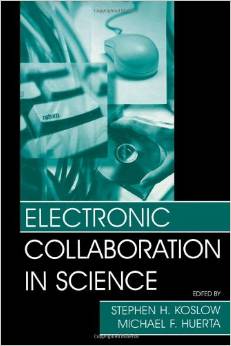
koslowhuerta2000Written in 2000, this appears to be one of the earlier works on collaboratories, which makes sense given that the coining of the term is not much earlier (attributed to Wm. A Wulff 1989). I think collaboratories are particularly interesting, arising as they did at the intersection of new interests in interdisciplinary science, and new networking technology. One of my interests is in tracing how (or whether) collaborative processes were rethought as we developed collaboratories. Given that this book is decidedly directed toward technical issues and challenges, rather than behavioral issues, it seems that not much of the early work was concerned yet with these questions.

For example, the first chapter, written by leaders in this area Gary Olson, Tom Finholt, and Stephanie Teasley, claims that behavioral science involvement is important to help with design of the new technologies, and with longitudinal evaluation. In other words, concerns that are primarily outside of doing the science itself.

You can definitely get the sense that the authors here are hoping to help others responding more effectively to a new technology/context. There are chapters on handling intellectual property, forming shared databases, and capturing information and knowledge in formats that can be preserved and reused.

The only portion of the book that makes a sustained argument about the social aspects of work in collaboratories is in a chapter by Richard T. Kouzes, “Electronic collaboration in environmental and physical science research” (p 89-112). In a section on the sociology of collaboration, Kouzas repeats the oft-heard maxim that collaboration is at the heart of science, but (as other before him have as well) he means that discoveries of science build on each other and are cumulative. It would be too easy to miss an important point he makes (and that I agree with) that moving to online media makes apparent what we have taken for granted in face-to-face contexts, such as gesture and other nonverbals. Kouzas argues that most of the problems with adopting groupware and other collaboratory tools is that the technology is primitive and very different from face-to-face (which feels more natural and and allows us to interact in ways that we expect) .

Kouzas lists four psychosocial issues crucial to the success of a collaboratory: attention to ritual, autonomy, sense of trust, sense of place. Ritual allows for the required mechanisms of social interaction. Autonomy determines how an organization is governed or regulated. Sence of place allows people to feel comfortable in their surroundings. Sense of trust allows people to cooperatively interact.

His analysis of the affordances of co-location is astute: “Autonomy … is implemented through informal communications, acquaintances, and associations that occur in any organization. Autonomy within a collaboratory must be embedded in a considered matter into the virtual organization. Trust is established among collaborators through shared experience. A collaboratory will have to engage some special means to establish the sort of trust that coworkers normally develop over time through informal means by meeting face-to-face and working together in the same place. A sense of place allows people to feel comfortable in their surroundings, providing security in which to be creative. … if a collaboratory can harness some of the design strategies that have been so successful in physical group settings, it can also create a sense of place and purpose among its dispersed members that will engender an enduring sense of affiliation and cooperation toward its goals. A collaboratory environment must provide the richness of information to allow for such natural interactions among collaborators.” (p. 105)

The question of how to achieve effective online experiences, using face-to-face as a starting point, is a question also asked by several communication scholars (think of the research on media richness or on interactivity). The insights here are an interesting contribution to the discussion.

Vos, J-P. (2005). Strategic Management from a Systems-Theoretical Perspective

19 Tuesday Aug 2014

Posted by MJ in Uncategorized

≈ Leave a comment

Tags

Luhmann, organizations, social construction, strategic change, systems

This article is from the same volume as my previous post on Luhmann.  In this section of the book, the chapters address the relation of Luhmann’s ideas–and those of the systems-theoretical (S-T) perspective more generally–on Strategic Management.

Vos covers a number of topics in this chapter, and I’m drawing out only one of them here, toward my interest in thinking about how we might use a systems-theoretic approach (and, I think, other types of constructionist approaches) in practice.  Vos provides two tables of information that are particularly useful.  The first is “Self-reference and levels of observation” (p.377).  The second is “Functional analysis of strategic management” (p.379).

Self-observation is a critical process for understanding organizations from a S-T perspective.  In a first-order observation, we watch something. In a second-order observation, we watch ourselves watching something.  There is a third-order as well, but that’s outside of what Vos describes here.  Vos suggests that when researchers adopt first-order observations, they observe what organizations observe: how organizations “de-tautologize” or “de-paradoxise” themselves to either operate strategically or reflect upon themselves strategically. This element of tautology or paradox comes from the basic assumptions of autopoietic systems set out by Luhmann (which I describe previously, so won’t discuss here).  For example, what do organizations temporarily (and artificially) hold as external or as constant, in order to plan for the future or make sense of past experiences?

More interesting to me what Vos lists as researchers’ second-order observations, which is to observe what organizations cannot observe: the organization’s blind spots in their own operations or what organizations cannot reflect on because of the way they perceive the world and the way they perceive how they reflect upon the world. I love this concept of blind spots. It acknowledges that when an organization does not consider a certain thing in its operations or in its reflections, this is not because they “missed it” or “left it out.”  From an S-T perspective, the organization literally cannot see it or perceive it, because it does not exist within their own worldview.

So, then, the contribution of the researcher can be to use these two orders of observation to describe an organization’s functions (functions are a basic concern of S-T, see previous post).

The functional analysis of strategic management by means of first-order observation aims to explore the way in which members of organizations give meaning to their organization’s strategic content, process and context.  In addition, by means of second-order observation, the functional analysis of strategic management is aimed at observing how organizations may or may not jeopardise their existence because of their strategic manoeuvres. (p. 379)

Researchers can “compare various functional equivalents” in each of these three areas to “find out their functionalities and dysfunctionalities.”  This information, made visible by the researcher, can then be introduced into the organization to explain how, why (and, I think, with what consequence) certain operations are adopted by the organization and others are not.

I think this is relevant not only for research, but also for any project ultimately aimed at transformational organizational change (like ASSETT). In any organization, some elements of strategic management are visible to the organization, and others are not.  It is not a “mere” matter of information or compelling reasoning.  It is a matter of the possibilities and constraints of a worldview.


Luhmann, N. 2000 (2005). The concept of autopoiesis.

17 Sunday Aug 2014

Posted by MJ in Uncategorized

≈ Leave a comment

Tags

autopoiesis, organizations, social construction, systems, theory

Luhmann2000Concise and well-laid out explication of basic presumptions of autopoiesis in the systems-theoretical perspective. It resonates with me for its consistent attention to function, its complementarity to structuration, and its usefulness for thinking about technology in a constructionist manner.

{This is a precis and potentially contains many of the same phrases or passages as the original essay. Any direct quotations of this text should first consult the original to ensure proper citation.}

“an organization is a system that produces itself qua organization” (p.54)

This statement looks circular, but isn’t really. By the end of the essay, the reasoning has been laid out.

Autopoiesis is definitional, not explanatory.  It constrains possible explanations.  These constraints are detailed in this essay.

Poiesis produces something – the creation of the system. That is, a system doesn’t merely exist. It continuously and steadily reproduces itself by means of its own products. Thus, the emphasis in poiesis is on reproduction, rather than production.

The base, most elemental, unit of the system is the event, which is temporal, not substantive. Yet an event has no essence.  It is simply something that, if we are focusing on a before/after distinction, we see as making a difference between “before” and “after”. To the extent that an event appears to have an essence, it is merely instructions for repetition of the selection (which is, technically, the next event).  Events always transition steadily from one to the next; they do not persist.  They leave all that follows to a subsequent event, hence producing a “surplus” of possibilities such that something suitable may be selected next. Because no two events can ever be exactly the same, there is also a steady reproduction of difference.

Therefore, precisely because every event must be constructed, this perspective presumes discontinuity in the moment-to-moment, and a steady decay of order and meaning. Any appearance of continuity (which is thingness, substance, or process) requires an explanation.

It is through autopoiesis that events are perceived as connected.  The autopoietic system is always dependent on prior production.  Recursive interlacing of operations creates connections and holds out prospects of connectivity. Recursions preserve both seemingly determinate selections connections as well as other possibilities. Connections do not form from intentions or purposes, as in action theory, because there is not concept of an actor.  There is no need, because possibilities are the residual of the event. It is every operation itself that “presupposes the recourse to and anticipation of other operations of the same system”.

Self-observation, the environment, self-organization. So, given that we have the basic element of production, we can ask how we get from there to “organization.” For this, Luhmann starts with claiming that the the autopoietic system must also be able to observe itself, i.e., to distinguish itself from its environment. Environmental boundaries are produced and reproduced. Only through this ability of self-observation can it distinguishes itself from the wholeness of the world. It is more reasonable that the AS itself does this demarcation rather than an outside entity.

But this self-observation is always located in history, self-referential, and meaning laden – and is itself a series of events.  The “self” is the term for what it is that observes itself observing, i.e. third order observation.

“In the process of self-observation, an organization does not observe itself as a stationary object whose qualities can be recognized. Instead, the organization uses its own identity only for the purposes of continuously attaching new determinations to it and subsequently giving them up again. For this reason, autopoietic systems can also create variations in their structures (this is called “self-organization”), insofar as such variations are compatible with the continuation of autopoiesis. All reflections on identity that propose stable self-descriptions by means of content-related properties must therefore proceed in a highly selective manner; in the process, they commit themselves to exacting normative demands and usually remain controversial.” (p56)

In self-organization, the system both produces and controls the uncertainty of itself with relation to its environment.  Here and elsewhere Luhmann is clear that there is no empirical way to specify the nature of a system’s environment.  Instead, this is created in the process of self-observation.  “Accordingly, autopoiesis is possible only as long as the system finds itself in a constant state of uncertainty about itself in relation to its environment, and as long as it can produce and control this uncertainty by means of self-organization.” p.56  Uncertainty is perceived, and then absorbed only as it is transformed to certainty as is relevant to the specific moment.  Uncertainty absorption is an adjustment to the changing states of perturbation of a system and its environment.

Now, an autopoietic system’s best response to uncertainty is to stick with what has gone before. So, there is often a lot of retrospective sense-making which makes both the organization and its relation to the environment see stable over time when in actually, it is being constructed moment by moment.  Structures (patterns of events), are produced/reproduced/varied/forgotten by operations for use in operations. [fn – agrees with Giddens in structuration, but goes further]. Autopoiesis can be a barrier to structural variations, making the system appear over a short time frame as rigid and inflexible. However, as the difference between the system and its environment grows over long periods of time, there is typically then an acceleration of changes

Operative closure. Autopoietic systems are operatively closed/autonomous. The system is not isolated from its environment, it’s just that it depends on its own operations for continued operation. Its operations must be sufficient. It can operate only in the context of its own operations. It depends on the structures being produced by these operations. [again, similar to Giddens]. Certainly an input/output perspective is, therefore, not sensible, but neither is a traditional “open systems” viewpoint, because the operative functions are not open to the environment.  The systems doesn’t operate inside of an environment, because the system constructs its own environment that it alone perceives.  Its structures regulate what it can perceive, and what it allows to take to create perturbation or undertake its own information processing. The system decides what is “other” and if the environment appears to conforms as environment, this is due to retrospective sense-making by the system. The construction of an environment also allows the system to externalize problems as not of its own making or its own participation in their making. To perceive that the world is made of niches, and that the system is one of those niches, without asking how the niches come to be. Nor can the environment prevent system entropy/decay, because this must be done in the moment to moment events.

Regarding the role of structures, these don’t ensure repetition of events, inasmuch as they regulate the transition from one element to the next. Therefore, to provide necessary orientation in this transition, there is a requirement for meaning (in the form of communication). Structures are functional, contingent, and possible under different conditions/in different forms. Structures by definition have meaning and are constituted and reconstituted within realm of other possibilities, or else they will decay and not move forward. Therefore although uncertainties need to be reduced and ambiguities clarified, these must also be regenerated in the process of meaning. i.e., uncertainty is both reduced and renewed.

Autopoiesis “depends on the fact that a system is capable of producing internal improbabilities and thereby deviating from the usual.” These deviations function as information, which “has the function of selectively restricting the possibilities for the continuation of its own operations combined with the additional function of being able to decide relatively quickly about connective possibilities.”(p.61)

In sum, a system is able to be “open” because its operative conditions are closed. in this way, it can “afford” its openness. [As Luhmann states in a later chapter, it is a “recursively closed organization of an open system”, not a closed system]

‘The preservation of existence is turned into the preservation of a difference.” (p.62)

Edited, originally published 2000, trans by Peter Gilgen
Luhmann, N. (2005). The concept of autopoiesis. In D. Seidl & K. H. Becker (Eds.), Niklas Luhmann and organization studies (pp. 54–63). Liber & Copenhagen Business School Press.
Switzer, J. (2008). An Analysis of a Decade of Research Published in JCMC

14 Thursday Aug 2014

Posted by MJ in Uncategorized

≈ Leave a comment

Tags

cmc, jcmc, lit review

A short piece that, after analyzing articles published in JCMC from 1995-2005, concludes “Overall, however, no convincing clear-cut future or emerging trends in populations studied, research methods utilized, or categories of inquiry and scholarship were discovered by examining the first 10 volumes published by JCMC.” (p549)

Switzer didn’t seem surprised, and neither am I (although that could be the benefit of hindsight). I am surprised, though, that only 10% of discussed theory as relating to the Internet/CMC or developed methodologies or frameworks. I would have guessed that number to be at least a little higher. This relates to my own interest of uncovering how studying tech enable transforming understandings of comm.

And it was fun knowing that one of my articles was one that was in their sample.

Switzer, J. (2008). An Analysis of a Decade of Research Published in the “Journal of Computer Mediated Communication.” In B. L. Kelsey & K. St. Amant (Eds.), Handbook of Research on Computer Mediated Communication (pp. 541–550). Hershey, NY: IGI Global.

Price, B. J. (2008). Computer Mediated Collaboration.

13 Wednesday Aug 2014

Posted by MJ in Uncategorized

≈ Leave a comment

Tags

cmc, collaboration, elearning, telework

What is collaboration removed from a specific time and space?

“…collaboration is a critical problem-solving, task resolution strategy in a broad range of contexts” p508

“…collaboration is central to living and working successfully in an information rich environment” p. 509–

Traditionally, collaboration is understood as happening in a specific space and time. But the contexts of collaboration are changing to be more and more distributed. So our understanding of collaboration must change in relation to space and time. The evidence is clear that we have to let go of our traditional expectations that collaboration = colocation. Works is changing (Teleworkers, outsourcing), education is changing (elearning), and mobile devices means everyone is connected, removing distinctions that used to be based on place

But the change to CMC contexts won’t eliminate the need for collaboration, because collaboration is called forth by the nature of the task. If need complex interaction and higher order judgment and decision making, collaboration is central.

Describes how collaboration is present in CMC across 4 “Themes”:

  • Peer review
  • Engaged learning
  • Consensus-building
  • Self-reflection

Price makes an important point, which is that because technology is always changing, specific examples of collaboration and CMC will be transient. The question I am left with, and hope to explore, is what is not transient? What is the “essence” of collaboration if location is distilled out? So that, in addition to documenting how people appropriate technology in creative ways, we can analyze those appropriations from a theoretical point of view. To anticipate future uses and to design new applications.

Price, B. J. (2008). Computer Mediated Collaboration. In S. Kelsey & K. St. Amant (Eds.), Handbook of Research on Computer Mediated Communication (pp. 508–526). Hershey, NY: IGI Global.

Recent Posts

  • Finn, Sellen, & Wilbur. 1997. Video-Mediated Communication
  • Christakis & Fowler (2009), Connected
  • Kappas & Kramer (2011). Face-to-face communication over the Internet
  • Cooper (2001). Ride the Wave
  • Koslow & Huerta, Kouzas (2000). Electronic collaboration in science.

Archives

  • November 2014
  • September 2014
  • August 2014
  • RSS - Posts

Tags

acceleration autopoiesis cmc collaboration collaboratories elearning groupware interdisciplinary jcmc lit review Luhmann organizations social construction strategic change systems telework theory

Blog at WordPress.com.

  • Subscribe Subscribed
    • What Michele is Reading
    • Already have a WordPress.com account? Log in now.
    • What Michele is Reading
    • Subscribe Subscribed
    • Sign up
    • Log in
    • Report this content
    • View site in Reader
    • Manage subscriptions
    • Collapse this bar
 

Loading Comments...