What Michele is Reading

~ and some thoughts on same

Tag Archives: cmc

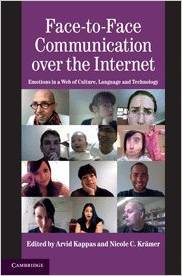
Kappas & Kramer (2011). Face-to-face communication over the Internet

08 Monday Sep 2014

Posted by MJ in Uncategorized

≈ Leave a comment

Tags

cmc, face-to-face communication, interdisciplinary research

kappaskramerThis edited volume is dedicated to what I call the “conversion” approach to the study of communication technology.  The essays here are looking at how communication as we know it in face-to-face settings converts or translates into an online setting.

A theme throughout the book is that we could not have predicted so many of the technologies we currently have available to us for communication. The particular interest of this volume is synchronous interaction, especially voice and image. There is an interesting undercurrent in many of the chapters of a mea culpa as in “you know what we said a few years ago about mediated communication never taking off because it couldn’t be as good as face to face?  Well…. forget we said that.”  This gives the essays a sense of scrambling to figure out not only what is currently happening in the communication phenomena, but also why their predictions turned out wrong. Some of the answers they offer are that the technological platforms are much better than anyone thought they could be, and the technology has provisions for more face-to-face simulations (like avatars), and it’s much more accessible now.

I’m inclined to give them the benefit of the doubt, but I am puzzled that there is also a continued clinging to the underlying assumptions of face-to-face as the presumptive and distinctive communication context.  Several chapters tease out this assumption, e.g., evaluating facial cues of avatars, visual cues in HCI, or the qualities of video communication.

Various authors argue that the next big question for users will be authenticity – of identity, attributes of the persons communicating, of their behaviors. I have argued that this is a primary characteristic of the conversion perspective. Authenticity presumes the priority of an original, a genuine prior object. Here, that genuine object is face-to-face communication, the original which is untainted or unbiased and against which all else is measured. Tampering, or the perception of tampering with this object (i.e., it’s not the genuine article) therefore is, indeed, an appropriate research question in this perspective. We would also anticipate that communicators would modify their of online behaviors to more closely approximate face to face communication (similarly, designers would aim for this approximation). One finding of this research, for example, is that users amplify the behaviors valued in face-to-face communication.

Despite this grounding, there is a glimmer of recognition that our adherence to the normalcy and presumption of face-to-face may wane,

Surely, some of the early reactions to the affordances and possibilities of cyberspace will look equally silly [as the early reaction to cinema] after one generation. We should not assume that the perception of these media, and their use and acceptance, will remain constant as they permeate the fabric of everyday life of users for whom a world that is not constantly blending online and offline work would be just as hard to imagine as a world without cars, airplanes, telephones, or readily available electricity would be to readers of this book. (p.10)

If this is the case, why publish a set of essays that do not challenge the conversion perspective?  One that might be more aligned with thinking as of 2001 rather than 2011? I think it is helpful that these help to complete the scientific record and the significance of interdisciplinary research.  These reports emerged from a workshop funded by the European Science Foundation, and document how the collaboration of social and behavioral sciences with engineering was instrumental in designing and developing applications.

Kappas, Arvid and Nicole C. Krämer. (Editors). 2011. Face-to-Face Communication over the Internet: Emotions in a Web of Culture, Language, and Technology. Cambridge University Press.

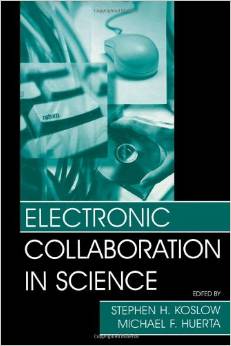
Koslow & Huerta, Kouzas (2000). Electronic collaboration in science.

26 Tuesday Aug 2014

Posted by MJ in Uncategorized

≈ Leave a comment

Tags

cmc, collaboration, collaboratories, groupware, interdisciplinary

koslowhuerta2000Written in 2000, this appears to be one of the earlier works on collaboratories, which makes sense given that the coining of the term is not much earlier (attributed to Wm. A Wulff 1989). I think collaboratories are particularly interesting, arising as they did at the intersection of new interests in interdisciplinary science, and new networking technology. One of my interests is in tracing how (or whether) collaborative processes were rethought as we developed collaboratories. Given that this book is decidedly directed toward technical issues and challenges, rather than behavioral issues, it seems that not much of the early work was concerned yet with these questions.

For example, the first chapter, written by leaders in this area Gary Olson, Tom Finholt, and Stephanie Teasley, claims that behavioral science involvement is important to help with design of the new technologies, and with longitudinal evaluation. In other words, concerns that are primarily outside of doing the science itself.

You can definitely get the sense that the authors here are hoping to help others responding more effectively to a new technology/context. There are chapters on handling intellectual property, forming shared databases, and capturing information and knowledge in formats that can be preserved and reused.

The only portion of the book that makes a sustained argument about the social aspects of work in collaboratories is in a chapter by Richard T. Kouzes, “Electronic collaboration in environmental and physical science research” (p 89-112). In a section on the sociology of collaboration, Kouzas repeats the oft-heard maxim that collaboration is at the heart of science, but (as other before him have as well) he means that discoveries of science build on each other and are cumulative. It would be too easy to miss an important point he makes (and that I agree with) that moving to online media makes apparent what we have taken for granted in face-to-face contexts, such as gesture and other nonverbals. Kouzas argues that most of the problems with adopting groupware and other collaboratory tools is that the technology is primitive and very different from face-to-face (which feels more natural and and allows us to interact in ways that we expect) .

Kouzas lists four psychosocial issues crucial to the success of a collaboratory: attention to ritual, autonomy, sense of trust, sense of place. Ritual allows for the required mechanisms of social interaction. Autonomy determines how an organization is governed or regulated. Sence of place allows people to feel comfortable in their surroundings. Sense of trust allows people to cooperatively interact.

His analysis of the affordances of co-location is astute: “Autonomy … is implemented through informal communications, acquaintances, and associations that occur in any organization. Autonomy within a collaboratory must be embedded in a considered matter into the virtual organization. Trust is established among collaborators through shared experience. A collaboratory will have to engage some special means to establish the sort of trust that coworkers normally develop over time through informal means by meeting face-to-face and working together in the same place. A sense of place allows people to feel comfortable in their surroundings, providing security in which to be creative. … if a collaboratory can harness some of the design strategies that have been so successful in physical group settings, it can also create a sense of place and purpose among its dispersed members that will engender an enduring sense of affiliation and cooperation toward its goals. A collaboratory environment must provide the richness of information to allow for such natural interactions among collaborators.” (p. 105)

The question of how to achieve effective online experiences, using face-to-face as a starting point, is a question also asked by several communication scholars (think of the research on media richness or on interactivity). The insights here are an interesting contribution to the discussion.

Switzer, J. (2008). An Analysis of a Decade of Research Published in JCMC

14 Thursday Aug 2014

Posted by MJ in Uncategorized

≈ Leave a comment

Tags

cmc, jcmc, lit review

A short piece that, after analyzing articles published in JCMC from 1995-2005, concludes “Overall, however, no convincing clear-cut future or emerging trends in populations studied, research methods utilized, or categories of inquiry and scholarship were discovered by examining the first 10 volumes published by JCMC.” (p549)

Switzer didn’t seem surprised, and neither am I (although that could be the benefit of hindsight). I am surprised, though, that only 10% of discussed theory as relating to the Internet/CMC or developed methodologies or frameworks. I would have guessed that number to be at least a little higher. This relates to my own interest of uncovering how studying tech enable transforming understandings of comm.

And it was fun knowing that one of my articles was one that was in their sample.

Switzer, J. (2008). An Analysis of a Decade of Research Published in the “Journal of Computer Mediated Communication.” In B. L. Kelsey & K. St. Amant (Eds.), Handbook of Research on Computer Mediated Communication (pp. 541–550). Hershey, NY: IGI Global.

Price, B. J. (2008). Computer Mediated Collaboration.

13 Wednesday Aug 2014

Posted by MJ in Uncategorized

≈ Leave a comment

Tags

cmc, collaboration, elearning, telework

What is collaboration removed from a specific time and space?

“…collaboration is a critical problem-solving, task resolution strategy in a broad range of contexts” p508

“…collaboration is central to living and working successfully in an information rich environment” p. 509–

Traditionally, collaboration is understood as happening in a specific space and time. But the contexts of collaboration are changing to be more and more distributed. So our understanding of collaboration must change in relation to space and time. The evidence is clear that we have to let go of our traditional expectations that collaboration = colocation. Works is changing (Teleworkers, outsourcing), education is changing (elearning), and mobile devices means everyone is connected, removing distinctions that used to be based on place

But the change to CMC contexts won’t eliminate the need for collaboration, because collaboration is called forth by the nature of the task. If need complex interaction and higher order judgment and decision making, collaboration is central.

Describes how collaboration is present in CMC across 4 “Themes”:

  • Peer review
  • Engaged learning
  • Consensus-building
  • Self-reflection

Price makes an important point, which is that because technology is always changing, specific examples of collaboration and CMC will be transient. The question I am left with, and hope to explore, is what is not transient? What is the “essence” of collaboration if location is distilled out? So that, in addition to documenting how people appropriate technology in creative ways, we can analyze those appropriations from a theoretical point of view. To anticipate future uses and to design new applications.

Price, B. J. (2008). Computer Mediated Collaboration. In S. Kelsey & K. St. Amant (Eds.), Handbook of Research on Computer Mediated Communication (pp. 508–526). Hershey, NY: IGI Global.

Recent Posts

  • Finn, Sellen, & Wilbur. 1997. Video-Mediated Communication
  • Christakis & Fowler (2009), Connected
  • Kappas & Kramer (2011). Face-to-face communication over the Internet
  • Cooper (2001). Ride the Wave
  • Koslow & Huerta, Kouzas (2000). Electronic collaboration in science.

Archives

  • November 2014
  • September 2014
  • August 2014
  • RSS - Posts

Tags

acceleration autopoiesis cmc collaboration collaboratories elearning groupware interdisciplinary jcmc lit review Luhmann organizations social construction strategic change systems telework theory

Blog at WordPress.com.

  • Subscribe Subscribed
    • What Michele is Reading
    • Already have a WordPress.com account? Log in now.
    • What Michele is Reading
    • Subscribe Subscribed
    • Sign up
    • Log in
    • Report this content
    • View site in Reader
    • Manage subscriptions
    • Collapse this bar
 

Loading Comments...