What Michele is Reading

~ and some thoughts on same

Tag Archives: groupware

Finn, Sellen, & Wilbur. 1997. Video-Mediated Communication

13 Thursday Nov 2014

Posted by MJ in Uncategorized

≈ Leave a comment

Tags

groupware, ICT history, video mediated communication, VMC

This was a trip down memory lane. Not in a bad way.  A volume in the important series Computers, Cognition, and Work, the editors present 25 studies of what was then an emerging phenomena–both technologically and socially.  In the thick of things before the technology had standardized, before we were certain of the value of the enterprise, and before we knew what VMC was supposed to look like, this volume demonstrates how science and research pushes a field forward, imagining, exploring and creating possibilities rather than taking things as a given.

Resulting from a workshop held in 1994, the volume has four sections but what I think are really two halves.  The first half of the volume consists mainly of difference studies, as in, what is the difference between VMC and face to face, or this type of VMC and that type of VMC, or this technological infrastructure and another one. This type of study is typical when a new communication technology is developed or introduced. And they can be very useful in the moment, helping to guide technology development.

The second half of the volume is more interesting to me, given my own interest in using technology to imagine new, previously unimaginable, possibilities for communication and interaction (rather than working to recreate as closely as possible what we have now). These are chapters that present new designs and that imagine the future, by researchers well known now, including Steve Whittaker, Bonnie Nardi, Hiroshii Ishii, Christian Heath, Paul Luff, Paul Dourish, and of course Robert Kraut.
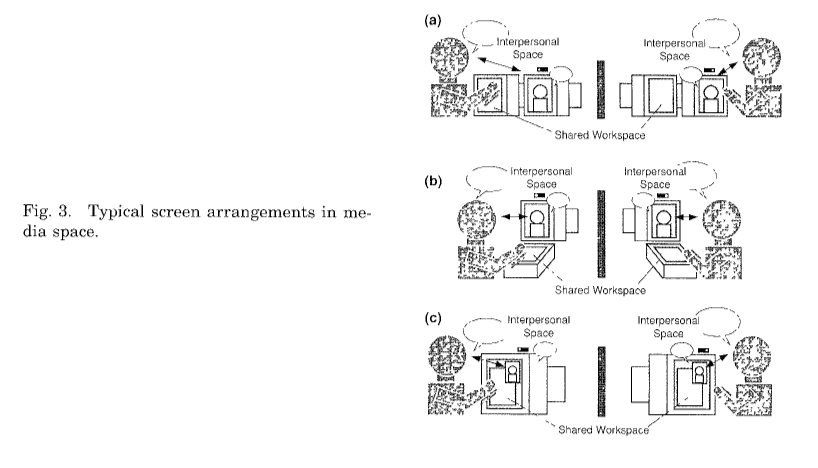
2014-11-10_1626The volume has captured in time ideas and designs that either were incorporated into technologies we take for granted today (such as Skype) or that were abandoned for any number of reasons.  EuroPARC’s RAVE. Bellcore’s Cruiser.  SunSoft Montage. MAJIC. NTT’s TeamWorkStation. DIVA virtual environment.  Xerox PARC’s media spaces. Active Desk. Portholes. Hydra. Rapport. Windseeker. This was a time of great imagination and possibility. Some of it is preserved here, to remember and to continue to inspire.

Finn, Kathleen E., Abigail J. Sellen, & Sylvia B. Wilbur. eds. 1997. Video-mediated communication. Lawrence Erlbaum Associates: Mahway, NJ.
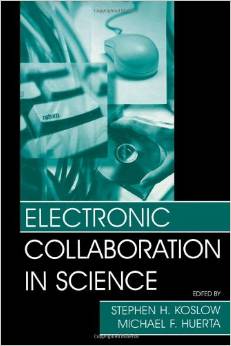


Koslow & Huerta, Kouzas (2000). Electronic collaboration in science.

26 Tuesday Aug 2014

Posted by MJ in Uncategorized

≈ Leave a comment

Tags

cmc, collaboration, collaboratories, groupware, interdisciplinary

koslowhuerta2000Written in 2000, this appears to be one of the earlier works on collaboratories, which makes sense given that the coining of the term is not much earlier (attributed to Wm. A Wulff 1989). I think collaboratories are particularly interesting, arising as they did at the intersection of new interests in interdisciplinary science, and new networking technology. One of my interests is in tracing how (or whether) collaborative processes were rethought as we developed collaboratories. Given that this book is decidedly directed toward technical issues and challenges, rather than behavioral issues, it seems that not much of the early work was concerned yet with these questions.

For example, the first chapter, written by leaders in this area Gary Olson, Tom Finholt, and Stephanie Teasley, claims that behavioral science involvement is important to help with design of the new technologies, and with longitudinal evaluation. In other words, concerns that are primarily outside of doing the science itself.

You can definitely get the sense that the authors here are hoping to help others responding more effectively to a new technology/context. There are chapters on handling intellectual property, forming shared databases, and capturing information and knowledge in formats that can be preserved and reused.

The only portion of the book that makes a sustained argument about the social aspects of work in collaboratories is in a chapter by Richard T. Kouzes, “Electronic collaboration in environmental and physical science research” (p 89-112). In a section on the sociology of collaboration, Kouzas repeats the oft-heard maxim that collaboration is at the heart of science, but (as other before him have as well) he means that discoveries of science build on each other and are cumulative. It would be too easy to miss an important point he makes (and that I agree with) that moving to online media makes apparent what we have taken for granted in face-to-face contexts, such as gesture and other nonverbals. Kouzas argues that most of the problems with adopting groupware and other collaboratory tools is that the technology is primitive and very different from face-to-face (which feels more natural and and allows us to interact in ways that we expect) .

Kouzas lists four psychosocial issues crucial to the success of a collaboratory: attention to ritual, autonomy, sense of trust, sense of place. Ritual allows for the required mechanisms of social interaction. Autonomy determines how an organization is governed or regulated. Sence of place allows people to feel comfortable in their surroundings. Sense of trust allows people to cooperatively interact.

His analysis of the affordances of co-location is astute: “Autonomy … is implemented through informal communications, acquaintances, and associations that occur in any organization. Autonomy within a collaboratory must be embedded in a considered matter into the virtual organization. Trust is established among collaborators through shared experience. A collaboratory will have to engage some special means to establish the sort of trust that coworkers normally develop over time through informal means by meeting face-to-face and working together in the same place. A sense of place allows people to feel comfortable in their surroundings, providing security in which to be creative. … if a collaboratory can harness some of the design strategies that have been so successful in physical group settings, it can also create a sense of place and purpose among its dispersed members that will engender an enduring sense of affiliation and cooperation toward its goals. A collaboratory environment must provide the richness of information to allow for such natural interactions among collaborators.” (p. 105)

The question of how to achieve effective online experiences, using face-to-face as a starting point, is a question also asked by several communication scholars (think of the research on media richness or on interactivity). The insights here are an interesting contribution to the discussion.

Recent Posts

  • Finn, Sellen, & Wilbur. 1997. Video-Mediated Communication
  • Christakis & Fowler (2009), Connected
  • Kappas & Kramer (2011). Face-to-face communication over the Internet
  • Cooper (2001). Ride the Wave
  • Koslow & Huerta, Kouzas (2000). Electronic collaboration in science.

Archives

  • November 2014
  • September 2014
  • August 2014
  • RSS - Posts

Tags

acceleration autopoiesis cmc collaboration collaboratories elearning groupware interdisciplinary jcmc lit review Luhmann organizations social construction strategic change systems telework theory

Blog at WordPress.com.

  • Subscribe Subscribed
    • What Michele is Reading
    • Already have a WordPress.com account? Log in now.
    • What Michele is Reading
    • Subscribe Subscribed
    • Sign up
    • Log in
    • Report this content
    • View site in Reader
    • Manage subscriptions
    • Collapse this bar
 

Loading Comments...