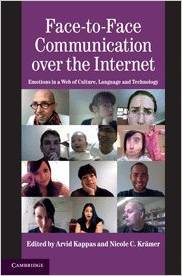
 This edited volume is dedicated to what I call the “conversion” approach to the study of communication technology. The essays here are looking at how communication as we know it in face-to-face settings converts or translates into an online setting.
A theme throughout the book is that we could not have predicted so many of the technologies we currently have available to us for communication. The particular interest of this volume is synchronous interaction, especially voice and image. There is an interesting undercurrent in many of the chapters of a mea culpa as in “you know what we said a few years ago about mediated communication never taking off because it couldn’t be as good as face to face? Well…. forget we said that.” This gives the essays a sense of scrambling to figure out not only what is currently happening in the communication phenomena, but also why their predictions turned out wrong. Some of the answers they offer are that the technological platforms are much better than anyone thought they could be, and the technology has provisions for more face-to-face simulations (like avatars), and it’s much more accessible now.
I’m inclined to give them the benefit of the doubt, but I am puzzled that there is also a continued clinging to the underlying assumptions of face-to-face as the presumptive and distinctive communication context. Several chapters tease out this assumption, e.g., evaluating facial cues of avatars, visual cues in HCI, or the qualities of video communication.
Various authors argue that the next big question for users will be authenticity – of identity, attributes of the persons communicating, of their behaviors. I have argued that this is a primary characteristic of the conversion perspective. Authenticity presumes the priority of an original, a genuine prior object. Here, that genuine object is face-to-face communication, the original which is untainted or unbiased and against which all else is measured. Tampering, or the perception of tampering with this object (i.e., it’s not the genuine article) therefore is, indeed, an appropriate research question in this perspective. We would also anticipate that communicators would modify their of online behaviors to more closely approximate face to face communication (similarly, designers would aim for this approximation). One finding of this research, for example, is that users amplify the behaviors valued in face-to-face communication.
Despite this grounding, there is a glimmer of recognition that our adherence to the normalcy and presumption of face-to-face may wane,
Surely, some of the early reactions to the affordances and possibilities of cyberspace will look equally silly [as the early reaction to cinema] after one generation. We should not assume that the perception of these media, and their use and acceptance, will remain constant as they permeate the fabric of everyday life of users for whom a world that is not constantly blending online and offline work would be just as hard to imagine as a world without cars, airplanes, telephones, or readily available electricity would be to readers of this book. (p.10)
If this is the case, why publish a set of essays that do not challenge the conversion perspective? One that might be more aligned with thinking as of 2001 rather than 2011? I think it is helpful that these help to complete the scientific record and the significance of interdisciplinary research. These reports emerged from a workshop funded by the European Science Foundation, and document how the collaboration of social and behavioral sciences with engineering was instrumental in designing and developing applications.
Kappas, Arvid and Nicole C. Face-to-Face Communication over the Internet: Emotions in a Web of Culture, Language, and Technology
 What Michele is Reading