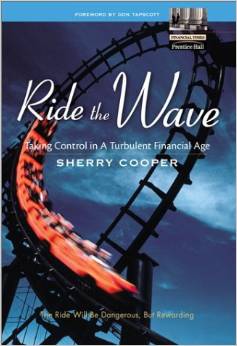
 At the turn of this century, the world was beginning the “Acceleration Age,” when the rate of change increases dramatically: things are not only faster, moving faster, etc., they are also stockpiling and accumulating. Especially knowledge. As an economist, Sherry Cooper focuses on economic policies in this book, and what is interesting is her argument that we need policies to manage and support throughput. This nod toward flexibility and adaptability was ahead of its time in 2001.
Ride the Wave is written more for the popular audience, by a practicing economist. It was also written before the U.S. recession, so it is interesting to see and follow what she highlights and what she does not. The choice of the term “acceleration” is an interesting one — yes, it is catchy. But acceleration “curve” assumes ever increase in the rate of change, a push toward faster and more. I guess acceleration is part of it, but eventually it results in a crash. Given that the US did have a crash, maybe the term was aptly chosen. But steady innovation and disruption doesn’t necessary imply cumulatively greater forward force. It could mean just a more dynamic and instable steady state. At any rate, her views about about technological innovation and the economy are consistently romantic . For example, “creative disruption is critical to economic growth leadership in the New Economy.” (p. 20) Terms like “killer applications” and “breakthrough technologies” are used liberally.
Setting aside the exuberance, she does predict something that has indeed become a significant factor, and that is the mobile Internet which will “expand the boundaries of the firm” (p. 35). She also was correct in anticipating various industry resistance to the possibilities created by the internet (which we can see today in the policy fights over net neutrality).
Cooper identifies key technological developments that she argues can make critical differences–disruptions–in substantial, rich ways in fundamental industries especially sales, communication, and medicine. She proposes that technological innovations happen in cycles or, more accurately, in waves. Innovations propel a wave of economic development. She calls these the “long waves.” Waves are traced back to industrial developments, and they coincide with wars. I find this interesting, but not quite convincing, because there is not a clear operationalization of “innovation” nor of how they are identified. In the last section, Cooper turns to globalization, where she makes an important point that we should not regard the computer or computing as the critical technology for disruption. Rather, it is the network: always on, mobile, and multi-platform. In other words, connection is the disruptor.
A particular anecdote is about automobiles is good to remember: in the 1920s, the Horse Association of America devoted a good deal of effort lobbying against cars. What will be the equivalent “lost cause” we see a hundred years from now?
Cooper, Sherry. 2001. Ride the Wave: Taking Control in a Turbulent Financial Age. Prentice Hall.
 What Michele is Reading